Folk Magical Realism: The Outcasts
A guest piece by George Parr from Hwæt Zine
George Parr
“Myth is not something to do with some past time, it’s actually there, in among us now. These stories are there, and they’re real, now. And that’s what’s exciting.”
Robert Wynne-Simmons
The discussion surrounding the 2024 re-release of Robert Wynne-Simmons’ The Outcasts (1982) seemed to focus on heralding it as some kind of lost bastion of the folk horror genre, lurking on the fringes of Irish cinema and waiting to finally take its place alongside the so-called ‘Unholy Trinity’ of the genre: Witchfinder General (1968), The Blood On Satan’s Claw (1971), and The Wicker Man (1973). This is in no small part down to Wynne-Simmons’ pedigree as the screenwriter on The Blood On Satan’s Claw, the most gruesome and salacious of the three films, but the director himself is uneasy about this characterisation: “I don’t know if I can really class The Outcasts as a horror film,” he told writer Vic Pratt in a 2024 interview. “But it is certainly a folk film.”
That hesitation to cast the film’s lot in with folk horror is notable. The Outcasts is certainly capable of darkness: characters die on screen, there are violent mobs and attempted murders, accusations of witchcraft and explicit sex scenes (perhaps even some supernatural bestiality). But even as it teeters on the edge of horror, the film never quite takes that next step. This isn’t a flaw of the film, or merely an act of restraint on the part of the filmmakers, but simply because, as Wynne-Simmons alludes, the film is centred not on horror but on folk. It is concerned not with what they’re capable of but what they believe, and of what essential truths are contained within the tales they tell around the fire.
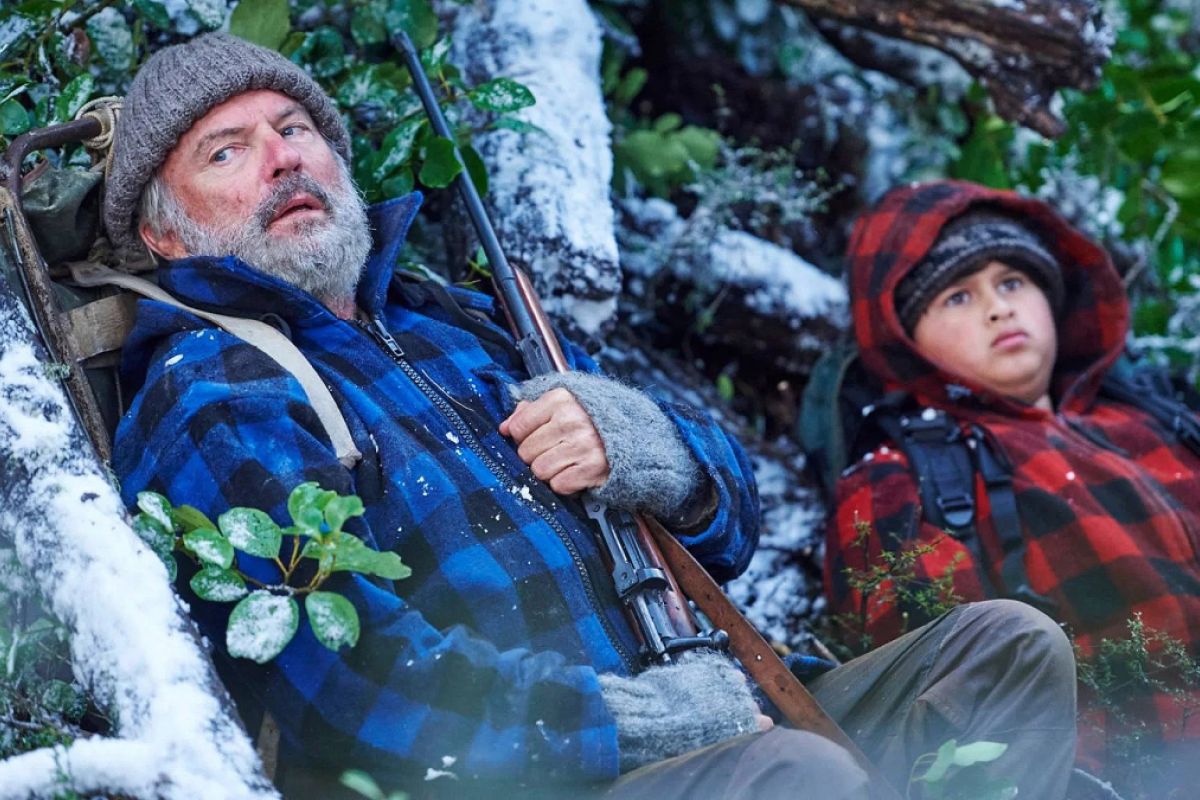
Filmed over a particularly cold winter in 1981 and ‘82 (filming was at one point shut down for weeks due to 14-feet deep snow), The Outcasts was one of the first films supported by the then-new Irish Film Board (now Screen Ireland), and was billed upon release as the first fully Irish-funded feature film in half a century (even if it did take a cash injection from a fledgling Channel 4 to get it over the line). Ireland remains something of a hotbed for folkloric films to this day, with the likes of Fréwaka (2024), You Are Not My Mother (2021), All You Need Is Death (2023), and Hokum (2026) coming in the last half-decade alone, so it’s fitting that this sorely overlooked gem, perhaps hyperbolically credited on Wikipedia as having “started the revival of the Irish film industry”, is finally available again on physical media. And, for one day only, on the big screen again thanks to our local cinema Hyde Park Picture House.
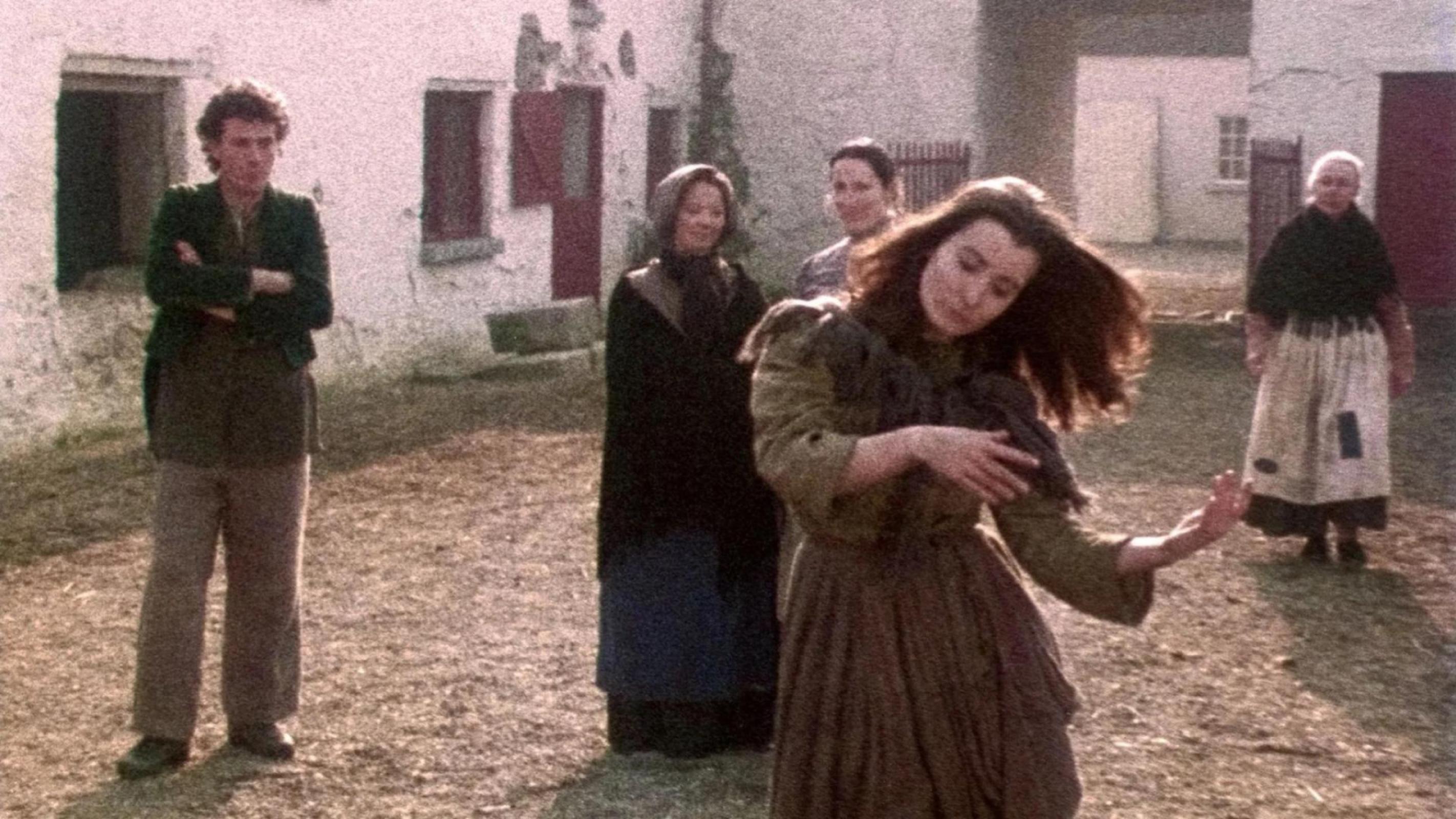
The Ireland imagined by The Outcasts is one in which the line between myth and reality is blurred, the former drifting into the latter like sea fog rolling in over the cliffs. Fireside tales are held as true. Local beliefs are not superstitions but wisdom. Rituals and customs are ingrained and essential. It is a vision of Ireland inspired by the collected folk tales of James Berry, in which pre-famine Ireland becomes like a legendary past lingering on the very edge of memory, as if the sheer scale of the tragedy had rendered a time before it fantastical. Here is a village where the tales told are reflected in the landscape, conjured in the minds of the villagers and then brought to life by the wind and rain.
It is also inspired by the writings of William Blake and W. B. Yeats, visionaries who saw the world a little differently than most. Blake infamously claimed to have had multiple mystical experiences, including seeing angels and being visited by the Old Testament prophet Ezekiel. Yeats then took inspiration from Blake but also from the wealth of Irish myth and folklore, and spent much of his life obsessed with mysticism and spirituality, joining esoteric groups like the Hermetic Order of the Golden Dawn. This is the lens through which their art and poetry were expressed. The world these men inhabited was more magical than that of those around them, though no less dark and full of sorrow.
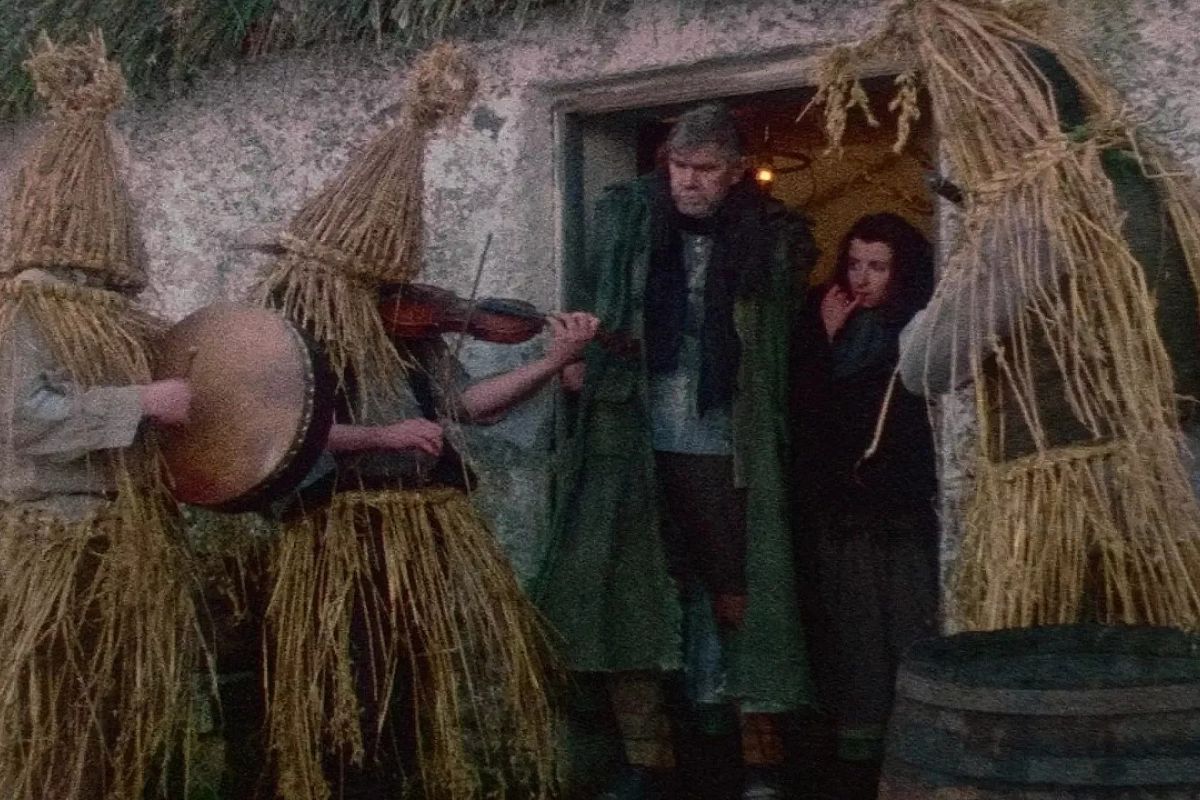
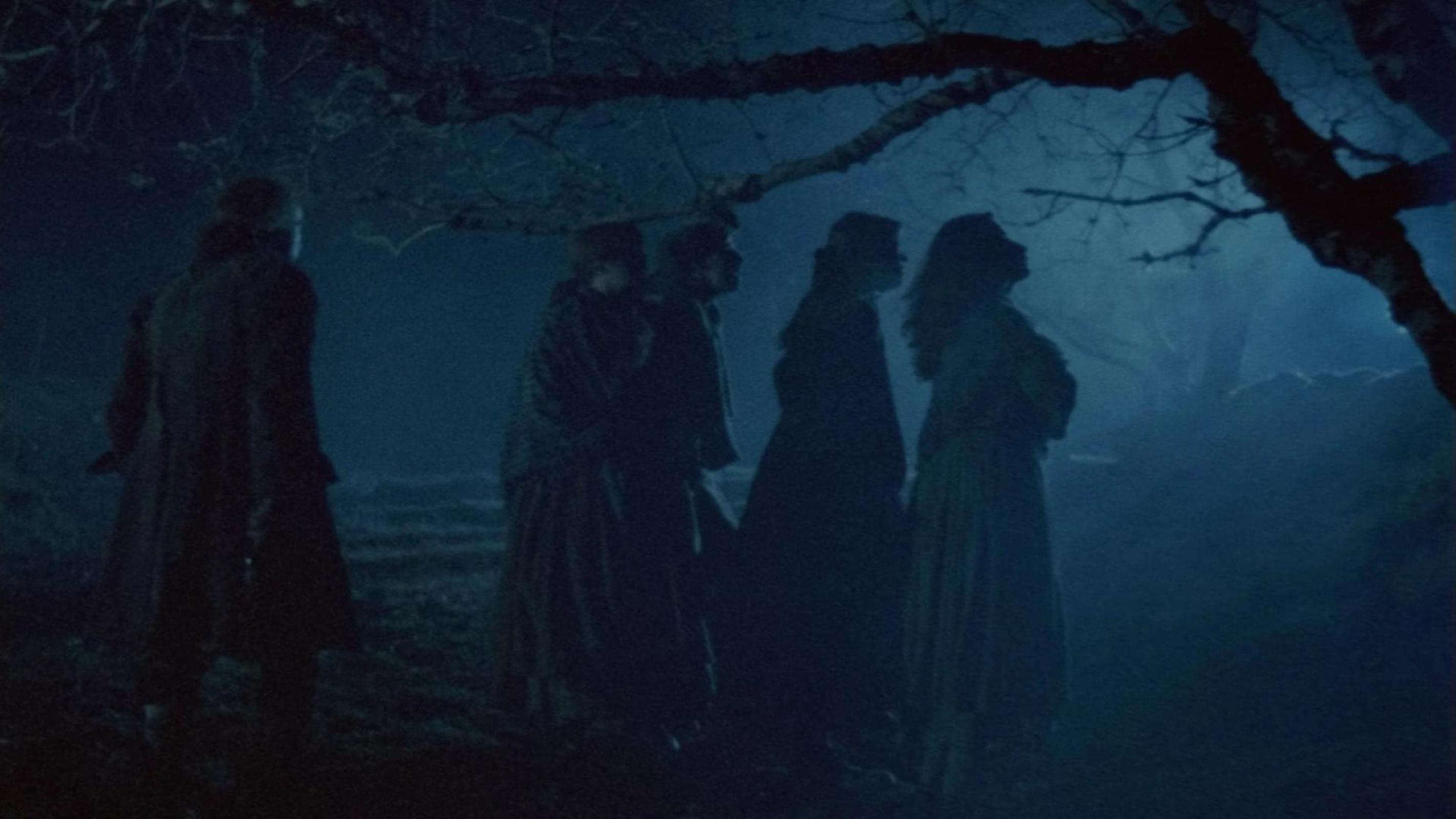
The Outcasts does something similar with its titular misfits, Maura and the elusive Scarf Michael. Maura is considered odd by her fellow villagers, which makes her the target of bullying. She’s told she “would believe anything the world told [her]”, as if believing in folk tales were an inherently bad thing, but in this there’s a suggestion that she’s more open to magic than most, if there is any to be found. And if there is, it comes in the form of Scarf Michael, an enigmatic figure who comes and goes as if only ever visiting from his true home in the Otherworld. He is at home in nature and is frequently associated with death, often sleeping in graveyards “for the company”. The villagers speak of him in hushed voices, claiming that he plays his fiddle with a bow strung using the hair of dead men and that he “wears a mask and a cloak like a great black bird all made of shadows, which he steals from folks when they die.” We first see him reflected in a pond, a visitor from across a watery threshold. Then later, he steps out from the shadow of a tree, as someone at one with the woods and the wilds. Is he a fairy? A shaman? The Green Man incarnate? All seem partly accurate. Yet when Maura sees his face and exclaims that he is only a man, he agrees, “Yes, only that.”
The character of Scarf Michael is one of the key components for The Outcasts’ signature strain of rustic mysticism. He acts much like a fairy of Irish legend, toying with the villagers for his amusement, with a streak of mischief that occasionally becomes outright mean. Yet he is grounded, brought to earth by Mick Lally’s stoic performance that sits perfectly poised on the edge of warmth and indifference. There is a trauma behind those eyes that might make it safer for him to retreat to the village’s fringes, and in doing so become something more than human. He’s a character that neither the villagers nor the viewer can ever truly know intimately.
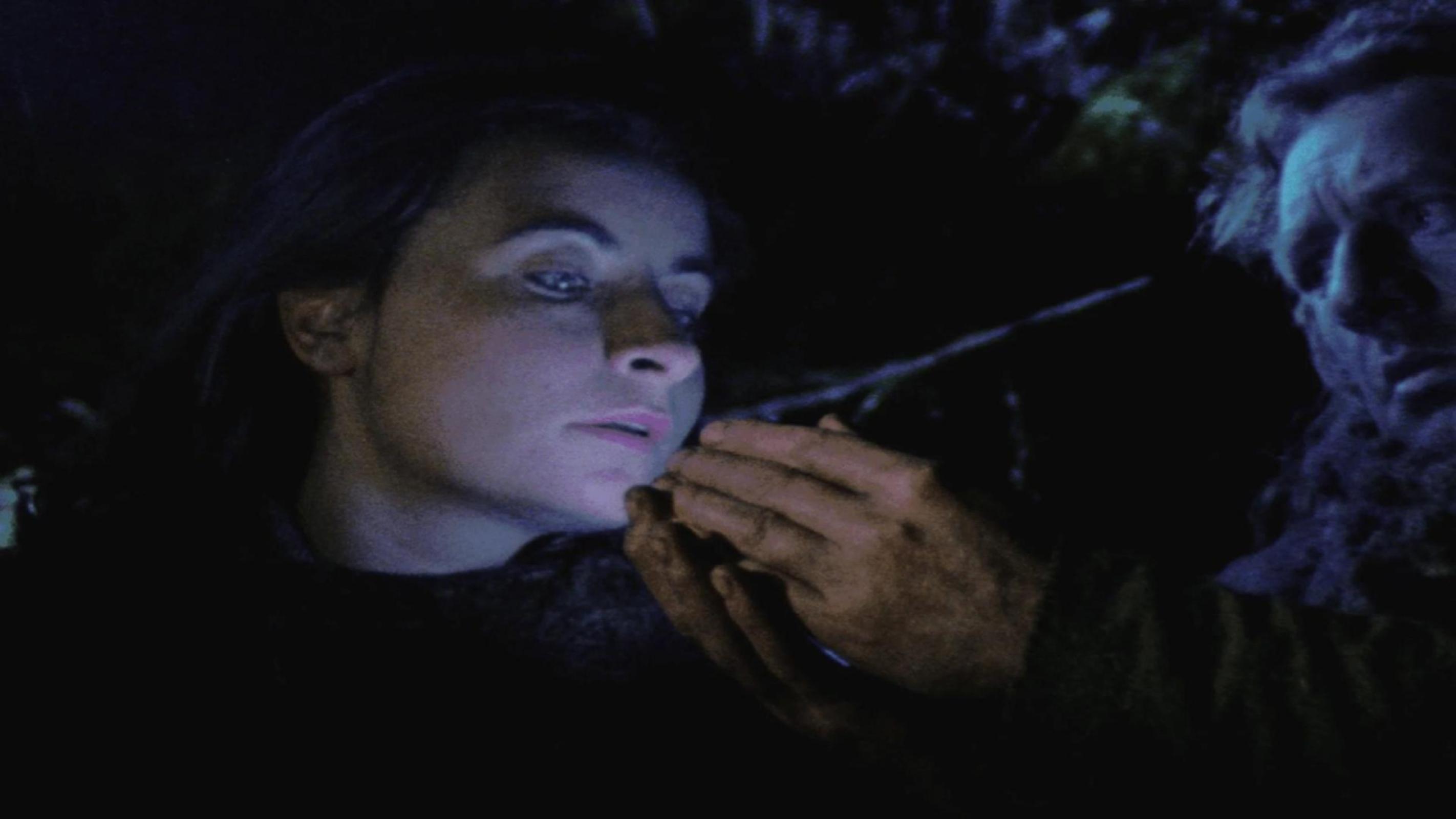
Perhaps even more fascinating, though, is Maura. Interpreted by some as a neurodivergent surrounded by neurotypicals who fail to understand her, we meet Maura as a quiet, unassuming woman seemingly bound for a life spent on her father’s farm even as her sister is getting engaged and readying to flee the nest. Mary Ryan plays Maura with wide, unmoving eyes full of fear and sadness and wonder. When one character somewhat pretentiously tries to point out the beauty of nature to her by speaking of the “glories of the earth”, Maura raises the courage to reply: “they frighten me.” Perhaps she sees a power in nature that others can’t. Perhaps she senses a similar latent power within herself, the same power that draws Scarf Michael to her.
In folk horror, the outsider is usually the victim of the piece, but here the outcasts hold a certain magic. Together, they become expressions of nature, the tragic flipside of which is that they are no longer welcome amongst human society. There’s a sense, though, that this power is in part a self-fulfilling prophecy on the part of the anxious villagers, whose supernatural fears are manifest in the characters of Scarf Michael and ‘Mad’ Maura. The extent of the latter’s abilities in particular are never made entirely clear, but the actual existence of any magic is less important than the locals’ belief in them. Michael and Maura become the very thing the villagers fear them to be and, as the potato blight begins, they become the scapegoats.
Whilst The Outcasts could, in one sense, be categorised as quietly magical, looking back favourably on a time when folk tales held more weight, it is certainly not a romanticised view of a lost, idyllic past. These characters eke out a tough existence, wading through boggy fields to work the land and huddling close to the fire to survive through cold, wet winters. The film may teeter on the edge of fantasy and reality, but the former is not necessarily an escape from the latter. Wynne-Simmons is under no illusion as to just how hard life in such a village would have been. Every character is world-weary and weather-beaten, familiar with toil and perpetually caked in mud. The events of The Outcasts occur amidst a mystical sheen of fog, but beneath it is a gritty village, rain-soaked and isolated, with locals who are prone to anger and violence when the future starts to look uncertain. Witchcraft is only invoked once in the film, but the same paranoia that characterised the witch trials certainly comes into play. If there is folk horror to be found in the film, it is here – neighbour turning against neighbour as cruelty and resentment brew into a moblike mentality.
The loneliness of the setting certainly has a hand in this too. Wynne-Simmons and lighting cameraman Seamus Corcoran capture a landscape of bleak beauty and wild desolation, of rolling moorland and tangled woods, of sodden thatch and pressing darkness. This is a damp, austere film with a tone that seeps out of every shot: rough yet strange, plain yet eerie. You can almost feel the weight of the mud as characters traverse the village’s soggy, winding lanes. Even the folk customs, which to modern sensibilities may seem odd and laced with mysticism, are grounded in the real: the film’s straw boys are based on a mumming tradition still practised to this day in parts of Fermanagh and Tyrone. Magic is only ever a subtle force, folded into the fabric of a harsh reality.
In this way, The Outcasts begins to unfurl into something very different from the Unholy Trinity, and is ironically perhaps most different from the demonic exploitation horror of The Blood On Satan’s Claw. If they are alike in any way, it is in their shared nature as attempts at folk tales on film. Wynne-Simmons originally wrote The Blood On Satan’s Claw as an anthology film, with the three separate tales later fused into a single narrative. The original vision would perhaps have seen the stories acting more like cautionary tales from a storybook. As it stands, The Blood On Satan’s Claw lacks the arcane uncertainty of folk tales. Its evil is too overt, too obviously monstrous. The Outcasts is, by contrast, full of mystery, even in the morality of the characters – beyond Maura it’s hard to tell who, if anyone, we should root for. The magic too is peculiar and mercurial, perhaps even dreamlike in its elusivity. From a nocturnal lover momentarily transformed into a goat to a bottle of beer turned into slime and dirt, it has the esoteric air of a folk tale, strange and symbolic. As Wynne-Simmons said in an interview with All You Need Is Death director Paul Duane, the film speaks to a form of storytelling that speaks “very directly in the gut, rather than in the head.”
In that same interview, Wynne-Simmons also says that “Through folk horror you can mix the mythic with the present day very effectively.” But even as it features some of the same tropes, The Outcasts deserves to be considered apart from folk horror, as something that perhaps asks some of the same questions but mostly finds different answers. In its lyrical, poetic depiction of a world adherent to the rules of folk tales, in which myth wanders in and out of reality, and magic is as real as the people it affects, The Outcasts does something that folk horror does not: it creates a sort of folk magical realism, where mythic figures, the subject of whispered warnings and fireside tales, truly are out there, howling in the wind, hiding amongst the trees. There is perhaps no other film that captures the spirit of the folk tale so vividly and so authentically.
By George Parr.
George Parr is one half of Hwæt, who we are working with as part of our Myth & Ritual: Folklore on Film season. They have created the artwork for the season, as well as a limited edition zine and have selected to screen The Outcasts on Sun 16 Aug, which they will introduce.